You can’t out-train a bad diet.
Training hard with no nutrition strategy = spinning your wheels.
Progress will slow.
Beginner gains don’t last. Long-term change takes patience and precision.
Motivation won’t save you.
Discipline and routine > fleeting motivation.
You’re not eating enough protein.
If you want to build muscle, protein isn’t optional it’s essential.
Fat loss requires a calorie deficit.
No hacks, no magic. Just science.
You can’t “spot reduce” fat.
Abs are made in the kitchen, not with 100 crunches a day.
Rest days matter.
More training isn’t always better. Recovery drives growth.
Tracking works – guessing doesn’t.
Want results? Know your numbers. Period.
You’re not training hard enough.
3 sets of 10 with 50% effort won’t build muscle. Push yourself.
There are no shortcuts.
The RP way: real science, real effort, real results.
#RPStrength#RPLifestyle#RPDietApp#Lifestyle#Fitness#Health#Hypertrophy#Training#RPHypertrophy#RPDiet#Gains#GymLife#Fitspo #agewell ##FitAfter50 #StrongWomenOver50 #MenopauseFitness #HealthyAging #OnlinePersonalTrainer #WomenOver50Fitness #50AndFit #StrengthTrainingForWomen #MidlifeWellness #AgelessStrength
Peanut Butter Protein Balls
Who doesn’t need more snack ideas, right? – especially low carb ones that are diabetes-friendly and good for blood sugar levels. I found this recipe on the Diabetes Meal Plans Australia website.
They keep stored in the fridge for months – though you’ll definitely be eating them much faster than that.
Best of all they are low in carbs, blood sugar friendly, and incredibly satisfying!
One ball is equal to one serve.
Peanut Butter Protein Balls
These are high protein, low in carbs, blood sugar friendly and incredibly satisfying!
Ingredients
- 3/4 cup Natural peanut butter or almond / cashew paste
- 1/2 cup Vanilla protein powder I used Protein Supplies Australia WPI
- 1 teaps Vanilla Extract
- 1/2 cup Shredded coconut
- 1/4 cup Slivered almonds
Instructions
Place all ingredients into a bowl and mix together to combine.
Next, get your hands into the bowl and roll the balls into 1/2 inch (1.5cm) bite sized balls - makes about 15 balls.
Place them into a container as you go and store them in the fridge. These will keep for months like this.
Recipe Notes
NOTE: one ball is one serve
Nutrition:
167 calories each ball. 5g Carbohydrate. 10g Protein. 12g Fat.
These protein balls get their sweetness from the protein powder and the vanilla extract.
When purchasing a protein powder, always check the labels for clean ingredients. Try to choose one that is stevia-based. According to research, stevia is one of the best sugar substitutes for people with type 2 diabetes and prediabetes, whereas some of the others have artificial sweeteners like aspartame, which aren’t ideal.
I sell the local Protein Supplies Australia here in my studio.
Natural peanut butter is the kind that has no sugar or preservatives added, Sanitarium has a good brand available from Coles and Woolworths. Aldi sells a natural peanut butter in their Organic range. Basically, ‘natural’ peanut butter is just ground peanuts, which is how peanut butter should be – not with added salt, added sugar, and preservatives!
Be careful when selecting vanilla extract. Many have fructose or sugar added, which is not a great choice for people with type 2 diabetes or prediabetes. Choose a ‘natural’ or ‘pure’ vanilla extract and always check the labels.
Satay BBQ Chicken Pizza
Who doesn't love a pizza? But as a general rule, they are definately not considered a diet friendly food choose. Well, do I have good news for you! Simpson's Pantry have bought out a new wrap, low carb keto. At the time of writing this (Nov 2021) they are only available at Coles supermarkets.
By using this wrap as your pizza base, and replacing peanut butter with PB2 powdered peanut butter, you can have your pizza and eat it too.
Naturally, you can replace the toppings with other meats, lean cuts only.
I have used the fresh Mozzarella balls in this recipe, as they are lower in calories then even light cheese.
Ingredients
- 1 40g Simpson Pantry Low Carb Keto Wrap 1 wrap. 98 calories, 8.1gP, 4.4gF, 2.3gC
- 2 tbsp Mayvers Protein Peanut Butter OR for less calories 225 calories, 12.8gP, 16.8gF, 5.2gC
- 2 tbsp PB2 Powdered Peanut Butter, dry (instead of peanut butter) 55 calories, 5.7gP, 1.7gF, 3.5gC
- 100 grams Fresh Mozzarella Cheese balls 264 calories, 17.9gP, 20.3gF, 3.4gC
- 3 tbsp Foutain BBQ reduced sugar 43 calories, 0.4gP, 0.2gF, 9.4gC
- 140 grams Cooked chicken breast meat 231 calories, 43.4gP, 5gF, 0g C
- 60 grams Onion, diced or sliced 18 calories (or as much/little as you like)
- 30 grams Capsicum, diced or sliced 8 calories (or as much/little as you like)
- 60 grams Mushrooms, sliced 1/2cup. 15 calories (or as much/little as you like)
- 1 – 2 teaspoons Italian Herb Blend as much or little as you like
- 1 – 2 tbsp Fresh basil as much or as little as you like
Instructions
Heat oven to 200 degrees celsius
Cover baking tray in non-stick baking paper
Mix the BBQ sauce and peanut butter paste/or powder together in a bowl.

Place wrap on top of the baking paper and spread the sauce mixture evenly over the wrap. Leaving approximately 1 cm around the edges free.

Sprinkle dry italian herbs over the sauce.
Taking 1/2 (50g) of the mozzarella balls, slice each into 3 or 4 slices and spread over the wrap.

Evenly distribute the chicken and vegetables over the wrap. Then break up the basil and sprinkle that over.
Lastly, take the remaining mozzarella balls, slice each one and place over wrap. Try and avoid putting in same place as the bottom cheese balls.
Bake in the oven for 10 – 15 minutes. For a crispier base, take the pizza off the baking tray, and directly on the oven rack after 5 minutes. Continue cooking until full bake time is up.
The complete pizza/wrap using the PB2 powder, not paste is 737calories. 27.9g Carbohydrates, 36g fat, and 69.7g protein .
So, as a half of pizza is the serving size, that equates to:
368.5 calories
34.85g protein
18g fat
13.95g carbohydrate
Could you be chronically stressed? Is your high cortisol ruining your ability to lose fat as your nervous system is spending too long in a sympathetic state?

😲The Sympathetic autonomic nervous system or state is our “Fight or Flight” or “Stressed Out” state.
💣It of one of the two autonomic nervous systems which control specific body processes, such as circulation of blood, digestion, breathing, urination, heartbeat, etc.
🧠If in this state for an extended period of time, you could experience:
❌ poor digestion/indigestion
❌constipation
❌diarrhea
❌anxiety
❌ shallow breathing
❌increased heart rate
❌poor quality sleep
❌restlessness
❌ night sweats
❌ decreased libido
❌fatigue
❌nervousness
❌ increased agitation/irritability
❌increased muscle tension
❌increased inflammation and
❌increased susceptibility to infections (i.e., frequent illness).
♨️This will all then derail your fitness goals of weight loss and muscle gain, if not controlled. So we need to manage our stress hormone “Cortisol”.
✅Studies have shown that there is an inverse relationship between Cortisol and Testosterone. Yes, ladies, we need testosterone too. If due to chronic stress, our Cortisol is consistently elevated then our average testosterone levels will then decline. 💯👉This in turn would see you struggling to build muscle and lose fat. 👎 😲
Cortisol draws glucose into the blood, and it just sits there. This triggers the pancreas to release insulin. Usually, this insulin would cause our muscles to draw up the glucose, but in our modern world of non-physical stressors, our muscles don’t need the glucose.
This excessive exposure to unneeded insulin makes chronically stressed people increasingly insulin resistant, and the more insulin resistant someone is, the harder it is for them to burn fat (1,2). Finally, cortisol inhibits the process that creates essential neurotransmitters such as serotonin (3,4). Serotonin is the “feel good” molecule most commonly associated with that feeling of euphoria you get after a good workout. The challenge is that with consistently elevated cortisol levels, the body loses its ability to regulate this and other neurotransmitters properly.
This is why people suffering from depression often show both low serotonin and high cortisol (3,4). This is a dangerous place to be when they need to lose fat because when someone feels stressed out and unhappy, a common solution they look to is to eat.
It doesn’t end there. Serotonin not only helps us feel happy, but it’s also a necessary precursor to melatonin, an important signaling molecule in the sleep cycle. When your body loses its ability to regulate serotonin, it also impacts its ability to make melatonin, and then not only is your stressed-out client unhappy, they can’t sleep either.
THERE IS HOPE – our goal is to get you out of a chronically stressed sympathetic state where cortisol is high all the time and into more of a stress rhythm where cortisol is limited to the mornings and around training sessions. The rest of the time you should be in a parasympathetic state to give your body the opportunity to build and recover.
✅ You need to engage in more parasympathetic (resting) activities. Try yoga, pilates, a massage, meditation, walk in nature. Try Dr Joe Dispenza, Mooji, or John Vincent on YouTube, they have excellent guided meditations.
✅ Aim to get 8 hours of deep, uninterrupted sleep. Start a wind-down routine, turn off sources of blue light (phones, tablets, computers) or put on a filter.
✅ Eat a good anti-inflammatory diet. Some foods that may help to keep cortisol levels stable include dark chocolate, bananas and pears, black or green tea, probiotics in food such as yogurt, and probiotics in foods containing soluble fiber. Don’t forget to stay hydrated.
✅ Exercise -Being physically active is beneficial to health and can improve a person’s mood. The appropriate amount of exercise depends on various factors, including a person’s physical fitness, and these factors play a part in how much cortisol the body will release during exercise. Not intense exercise.
✅ Supplements – Both fish oil and an Asian herbal supplement called ashwagandha have shown the ability to reduce cortisol levels, so taking these supplements alongside a healthful diet could be beneficial.
- Geer EB, Islam J, Buettner C. Mechanisms of glucocorticoid-induced insulin resistance: focus on adipose tissue function and lipid metabolism. Endocrinol Metab Clin North Am. 2014;43(1):75-doi:10.1016/j.ecl.2013.10.005
- Kersten S. Mechanisms of nutritional and hormonal regulation of lipogenesis. EMBO Rep. 2001Apr;2(4):282-6. doi: 10.1093/embo-reports/kve071. PMID: 11306547; PMCID: PMC1083868.
- Tafet GE, Toister-Achituv M, Shinitzky M. Enhancement of serotonin uptake by cortisol: a possible link between stress and depression. Cogn Affect Behav Neurosci. 2001 Mar;1(1):96-104. doi:10.3758/cabn.1.1.96. PMID: 12467107.
- Tafet GE, Idoyaga-Vargas VP, Abulafia DP, Calandria JM, Roffman SS, Chiovetta A, Shinitzky M.Correlation between cortisol level and serotonin uptake in patients with chronic stress and depression.Cogn Affect Behav Neurosci. 2001 Dec;1(4):388-93. doi: 10.3758/cabn.1.4.388. PMID:
12467090.
From 5:2 to 16:8, do intermittent fasting diets work, and what are the challenges?
I saw this article posted on abc.net.au on the 27th July 2021 regarding intermittent fasting. But before we get into the article, I just wanted to throw my two bobs worth in. (gosh, young folk won’t get that)
On a personal note, I have tried both of these diets. Back in 2011 I competed in and won, the Figure division of the Queensland INBA bodybuilding competition (thank you very much). After all those months of preparation and a strict diet, my relationship with food became very unhealthy.

I was binge eating all the time, and all I thought about was food. I tried all the old ways I knew to get my appetite under control, but nothing worked.
I am a big fan of Dr. Michael Mosley, and had watched one of his documentaries in which he investigated numerous fasting regimes. After his experiences, he then came up with the 5:2 diet. This made a lot of sense to me. So on every Monday and Thursday, I would only eat 500 calories. This was exactly what I needed. I actually began to look forward to my fasting days, and my hormones leptin and ghrelin seemed to become under control. These are your hunger hormones. Ghrelin tells your brain you are hungry, and Leptin tells your brain you are full.
As for Intermittent fasting, I have been practicing that for over 3 years. At least 5 days a week, I will not eat until anywhere from 11am to 1pm. Then only give myself an eating window of 7 to 8 hours. Primarily I am not doing this for fat loss, but it does keep my calories under control. But it is more to reduce inflammation in my body (helping with my autoimmune disease) and leukemia, and also bringing my body into Autophagy. Click on the link to read more about this. https://www.medicalnewstoday.com/articles/autophagy#health-effects
Anyway, enough about me. The remainder of this post will be taken directly from the ABC article. …………………
ABC Science / By Kate Midena for Catalyst
Samantha Roberts is three weeks into a six-week fasting experiment, and she’s tired.
She’s hungry, she hasn’t been sleeping well, and she hasn’t lost any weight.
“I feel like I’m trying to change, but I don’t think I’m changing for the better,” she says.
“I think I’m meaner. I think I’m shorter with people. I’m not as happy as I used to be.”
Samantha’s experience is not uncommon; many diets bring with them moments of hopelessness and frustration, especially when you’re required to overhaul ingrained habits.
Under the guidance of dietitian Joanna McMillan and an expert team, Samantha is one of five people participating in a Catalyst fasting experiment, looking at intermittent fasting’s impact on weight loss, aging, gut bacteria, and metabolic health.
She is doing the 16:8 plan.
“I don’t eat from 8 o’clock at night till 12 midday the day after, so I fast for 16 hours,” Samantha explains.
“Mornings I have black coffee, I’m allowed black coffee, black tea. But just no food.
“I’m getting there [but] maybe I didn’t realise what I was getting myself in for.”
Fasting is about more than weight loss
Samantha’s husband Kevin is also participating in the experiment, but he’s on the 5:2 diet.
Kevin must eat a healthy diet for five days but cut his kilojoules down to 2,500 on Tuesdays and Thursdays — that’s less than a quarter of his regular intake.
Unlike Samantha, he starts to lose weight immediately.
“I managed to pull an extra notch on my belt for my pants, so that’s an inch down on my belt size,” he says.
“I’m happy to carry on.”
The research into the effectiveness of fasting diets “really is in the early days,” but Dr McMillan is hopeful that her experiment will show the benefits of fasting reach beyond weight loss.
“We’re so obsessed with weight in this culture, we talk about diet in terms of just weight loss. But [diet] is about what we eat and its impact on our whole body,” she says.
“What the research seems to show is that, at least in the short term, fasting is at least as effective as a traditional calorie-controlled weight-loss diet.
“But if we only look at fasting as a weight-loss trend, we demean the research we do have into fasting.”
So what else might fasting be good for?
Early studies have shown that in as little as four weeks, switching from the fed to the fasted state can relieve health issues from inflammation to arthritic pain to asthma, start cellular repair, and increase longevity.What does science have to say about intermittent fasting?Eating plans that prescribe when to eat, and less so what to eat, are having a big moment. But is there evidence to support this approach to eating — and if so, which method is best?Read more
But one area Dr McMillan is particularly interested in is fasting’s impact on metabolic health — things like the body’s blood glucose and insulin levels.
“Metabolic health [refers to] the way your internal body systems are working, and if they’re working effectively,” she explains.
“If your metabolic health is out of whack it could mean your cholesterol is running high, or your glucose levels are high.
“It’s a catalogue of things that lead to poor health.
“Weight is a symptom, not the measure.”
Both Samantha, 49, and Kevin, 52, have “harmful levels of fat around their organs, and show signs of elevated blood sugar and insulin resistance”.
“If they do nothing, they’re likely to have type 2 diabetes within a decade,” Dr McMillan says.
“The question for [them] is, can fasting help to get your body responding better to insulin?
“We want to … get your body responding better.”
Fasting brings much-needed structure to eating
Dr McMillan says that one of the benefits of a fasting diet, be it the 5:2 or the 16:8, is that it gives structure to eating and puts a stop to snacking.
“We are in a food environment that we’ve never been in before, and this is really the first time in human history we’ve been in this situation, where so much food is available to us all the time,” she says.
“So this fasting method at the very least stops that eating after dinner.”
Kevin is already worried that his eating habits are catching up with him.
Before the experiment started, he’d typically drink a case of beer each week, and often pick up a bacon and egg roll or a pie on his way to work as a butcher.
“I wanted to give fasting a go because of my appearance, my body. I’m getting a bit bulging around the torso,” he quips.
For Samantha, a hairdresser, her eating patterns are all out of whack thanks to being on her feet with clients all day.
“Sometimes I don’t realise that I’ve actually eaten because I’m so busy,” she explains.
“I eat and then I don’t think I’ve eaten and then I eat again and then I realise I did eat, but I’m so busy that I forget.
“I do have a mirror in front of me all day, but I don’t actually look up at me. It’s a shock when I see me.”
The hope is that six weeks of an intermittent fasting diet will help Kevin and Samantha eat mindfully.
“What we certainly know is that getting your calories down is beneficial, and this is another option,” Dr McMillan says.
“After dinner, the kitchen’s closed. It simply stops that snacking that you tend to eat while you’re on the sofa.”
It’s also about eating good food
But intermittent fasting isn’t just about going without — it’s also about choosing nutritious food when you can eat, to provide lasting energy to get through the fasting window.
Diet quality is critical to the success of intermittent fasting diets, says lifestyle disease specialist Sam Hocking.
“I think one of the things where people can go a bit wrong with these diets is that idea of doing the 5:2 [and thinking], ‘there are two days where you have to restrict your calories but on the other five days you can eat whatever you like’.
“You can’t have the day where you’re partying all day and eating and drinking and then expect to get the benefits.
“You’ve got to eat healthily on the normal eating days.”
For Samantha and Kevin, this means stocking their pantry with lots of wholegrains, fruit and veggies, nuts and seeds, lean meats, and avoiding processed meats and snacks.
It also means restricting alcohol.
“As of last week, I drank approximately 48 bottles of beer less than what I’d normally consume,” Kevin laughs.
“The things that I’ve been eating differently are pumpkin, tofu, couscous, and sweet potato chips. [I have] just small pieces and other things mixed in with my other vegetables.
“I’m loving it, it’s just the food I’ve got to eat to get where I … want to be.”
The realities of a fasting diet
In the first six weeks, Samantha finds it’s sometimes hard to incorporate the changes into her grocery shop, even though she has meal plans and expert advice.
“I’m just trying to manage everything,” she says.
“To make sure I’ve shopped, to make sure I’ve got enough vegetables, to make sure I’ve got enough plant-based stuff.
“[I have] to be really organised — I have never spent this much time in my kitchen. I’m always cleaning the kitchen ’cause I’m making so much stuff.
“It’s a whole lifestyle change.”
On the 16:8, another challenge Samantha faces is waiting until midday to eat.
“There’s no talk about food, it’s banned. Till 12 o’clock,” she says.
“It’s quite hard hitting I think, more than I thought it would be. If I’m up at 5.30, it’s six-and-a-half hours with no food. It’s a long time.
“From 12, I’ll try and have some eggs. And then at like 1, I’ll try to have lunch, and then I’ll have fruit a lot more.”One thing she has to watch is “panic eating” in the minutes before 8:00pm.
“I think I have a personality, if somebody says you can’t have that water, then I want it even more. I think my personality is like that, but I think it’s a sense of panic,” Samantha says.
“[I think], ‘What else am I going to cram in before 8 o’clock?’.
“The worst thing is, I actually don’t feel like I need something else to eat, but I’m eating it because if I don’t, I’m not going to eat until tomorrow again.”
Kevin acknowledges “it’s more tricky for Samantha than for me”.
“She’s finding it hard in the mornings to not eat till 12 o’clock,” he says.
“She wakes up early, she starts to stress out a bit, I think … and gets a bit frustrated.”
But Samantha is determined to stick with the plan.
“My expectations were pretty high, but at least I’ve done something, and I’m still doing it,” she says.
So did it get easier?
After six weeks of participating in the fasting experiment, Samantha and Kevin settle in to their fasting patterns, and commit to sticking to them for a little while longer.
Their cravings abate, they become more comfortable with feeling hungry, and there are no bad foods in the pantry.
“[It was] totally a positive experience, I’ve enjoyed it — I know I’ve whinged. I have whinged a lot,” Samantha says.
“I feel better. I know [when] I don’t want to eat, I’m happy just to leave it at 8 o’clock.
“As long as I prep, I’m finding it better, even if I can’t find time for shopping.
“As long as I’ve got the vegetables and fruit at home, we’re good.”
And did it make any difference?
When Dr McMillan conducts her final tests to see how Kevin and Samantha have tracked, the results “are a little unexpected”.
Over the six weeks, Samantha lost 3.5 kilograms and Kevin 8.5 kilograms — but Kevin’s weight loss is actually “some cause for concern”.
“More than half of Kevin’s weight loss came from lean body mass – most of it [was] muscle,” she says.
“Lean muscle [is] crucial for staying healthy as we age. So, going forward Kevin — and anyone taking up fasting — needs to ensure they also do exercise.”
There has also been little change to Samantha and Kevin’s gut health.
But there has been “a really big metabolic improvement” for them both.
In particular, Samantha’s fasting insulin levels reduced, and her fasting blood glucose levels came down to “the normal category”, which means she reduced her risk of developing type 2 diabetes.
“This is a really powerful message, because you haven’t actually lost a lot of weight, but you’ve seen that really big metabolic improvement,” Dr Hocking says.
“Even for someone who doesn’t lose any weight, if your metabolic health has improved because you’re eating better and you’re exercising and getting enough sleep, you’re in a far healthier position.”
Dr McMillan says Samantha “epitomises the promise of fasting for me”.
“She has managed to overcome a really tough journey through my experiment and embrace a new way of eating,” she says.
‘It’s not going to be right for everybody’
While the results of Dr McMillan’s intermittent fasting experiment are promising, she warns that fasting is “not a magic bullet” for weight loss or overall health.
It’s also a method that should not be overdone; fasting for too long “stresses your body too much”.
“Fasting is one tool in the toolkit … one potential option to add,” Dr McMillan says.
“It’s not going to be right for everybody … we just don’t know what the optimal regime or program is, and it might be different for individual people.
“In the end, you have to choose the approach to healthy eating that works for you.
“There’s no doubt that we’re leaving [Samantha and Kevin] in a healthier spot, and the challenge now is just to keep up the good work.”
Can one binge make you fat?
Written by Alex Leaf and verified by the Examine.com Research Team. Last updated on Dec 20, 2018
While regular overeating leads to fat gain, a lot of the weight you gain from just one binge will simply be water, especially if your starting glycogen stores are low and your food rich in carbs.
From Examine.com, their evidence-based analysis features 28 unique references to scientific papers.
Think of the last time you ate a big meal then weighed yourself the next day. Perhaps it was Thanksgiving, Christmas, or New Year’s, and your scale showed a gain of several pounds. But how much of that is fat?
Very little, it turns out.
There are about 9 food calories in a gram of fat, so in theory you could gain one pound of fat (454 g) by eating some 4,000 calories more than you burn. The actual number may be closer to 3,500,[1] so if you eat 500 extra calories per day for a week, you might gain a pound of fat.
But not if you eat 3,500 calories in a single meal. There’s a limit as to how much food your body can turn into fat in just a few hours. What your body cannot process for storage during that time, it tries to burn (your temperature rises slightly) and to excrete (you end fighting with your family for access to the toilets).
And of course, digestion itself has an energy cost.
Thermogenesis
Some of the calories in the food you ingest will be used to digest, absorb, and metabolize the rest of the food, and some will be burned off as heat. This process is known under various names, notably diet-induced thermogenesis (DIT), specific dynamic action (SDA), and thermic effect of food (TEF).[2][3]
DIT represents about 10% of the caloric intake of healthy adults eating a standard mixed diet,[4] but your actual number will depend on several factors, which include your lean body mass and the composition of your meal. The energy required to digest each macronutrient (its DIT) can be expressed as a percentage of the energy provided by this macronutrient:[5]
- Fat provides 9 calories per gram, and its DIT is 0–3%.
- Carbohydrate provides 4 calories per gram, and its DIT is 5–10%.
- Protein provides 4 calories per gram, and its DIT is 20–30%.
Also, if you ate too much, you may start feeling restless and consequently fidget more as a subconscious way to burn off the caloric excess. Burning calories through fidgeting is a kind of nonexercise activity thermogenesis (NEAT),[6][7] “the energy expended for everything we do that is not sleeping, eating, or sports-like”.[8] NEAT varies between individuals, which is why some people seem to gain fat more easily than others.[6]
Overeating will increase energy expenditure through dietary induced thermogenesis (DIT) and nonexercise activity thermogenesis (NEAT). The magnitude of your DIT depends on the composition of the meal, whereas the magnitude of your NEAT depends on size of the meal and individual variables.
Glycogen
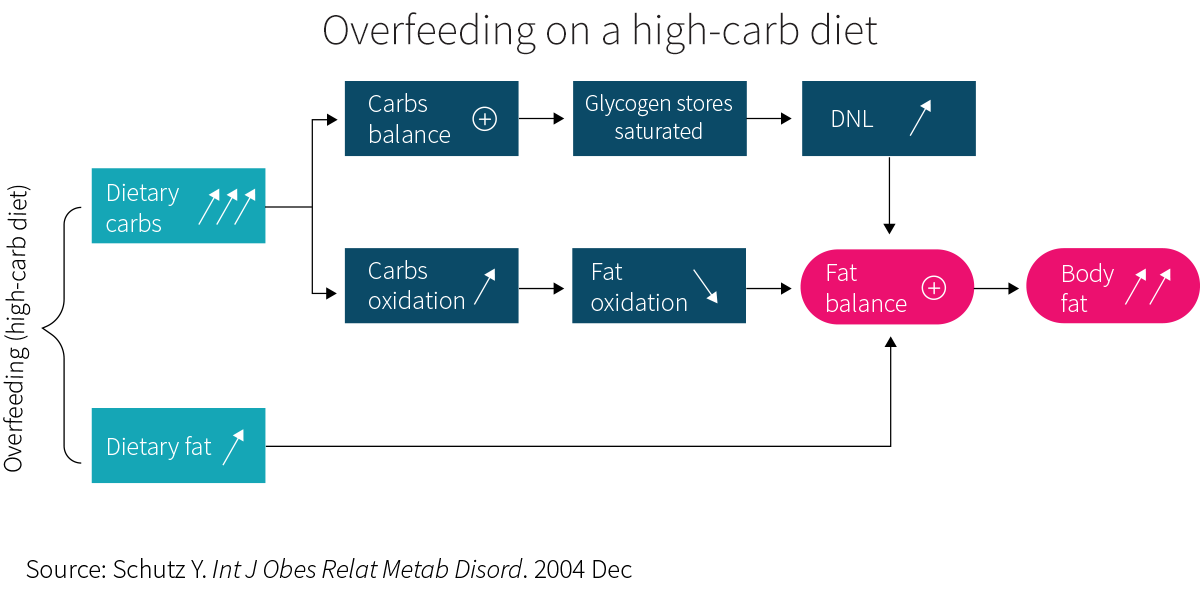
Your body has two ways to store the carbs you eat. It can transform them into fat, in a process called de novo lipogenesis (DNL), but first it’ll want to refill its glycogen stores in the liver and skeletal muscle.
Glycogen in the liver
Your body uses your liver for short-term storage of glycogen. When you fast (which most of you do overnight as you sleep), your liver is where your brain will first search for the glucose it needs to keep functioning. After a fast of 12–16 hours, when liver stores are 25–50% depleted, each kilogram of the average liver still contains 44 grams of glycogen (range: 14–80 g),[9] so we can estimate the maximal capacity of the average liver at 60–90 g/kg.
Glycogen, moreover, cannot be stored on its own: it must be bound to water. In your liver, each gram of glycogen comes along with 2.4 grams of water.[10]

When full of glycogen, the average, healthy, human-male liver is heavier by 289–432 grams (0.6–1.0 lb), whereas the average, healthy, human-female liver is heavier by 241–364 grams (0.5–0.8 lb).
Glycogen in the muscles
Glycogen also gets stored in your muscles.

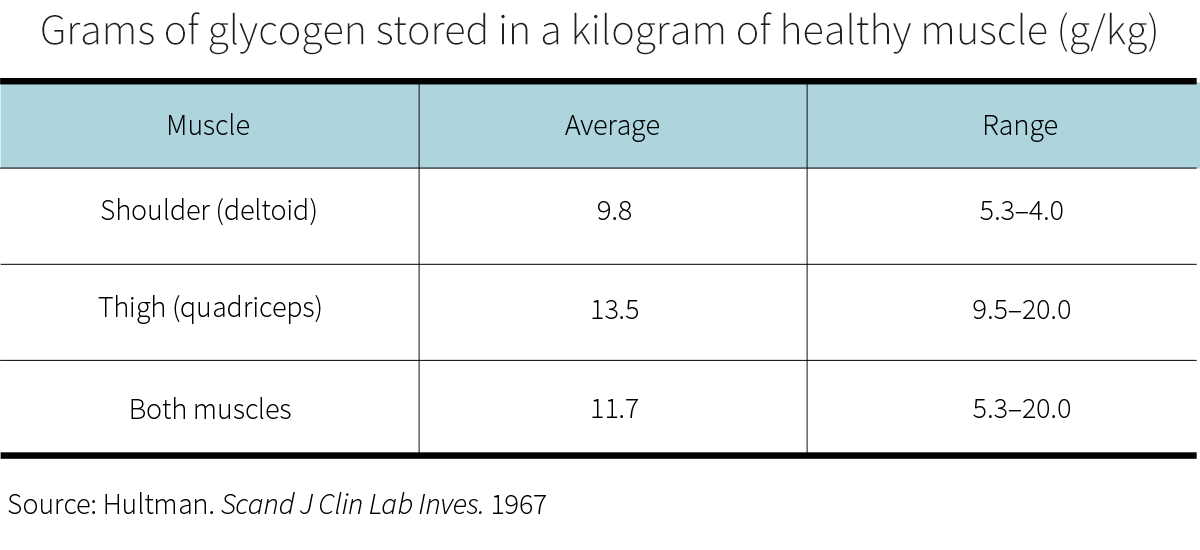
Of course, typical muscle mass varies greatly between individual men (22–40 kg, typically) and women (15–30 kg).[14] By combining those numbers with an estimation of the muscles’ average glycogen content (11.7 g/kg), we can further estimate that, in their muscles, men carry 256–466 grams of glycogen, and women 175–350 grams.
As we saw, however, glycogen cannot be stored on its own: it must be bound to water. In your muscles, each gram of glycogen comes along with at least 3 grams of water,[15] which can become 17 grams if you co-ingest a lot of fluid and a lot of carbs after exercising in a hot, dry environment.[15]
Therefore, in normal circumstances, a man who carries 31 kilograms of muscles (68 lb) also carries in those muscles 361 grams of glycogen and 1,083 grams of water (0.8 and 2.4 lb). And if he drinks a lot while ingesting his carbs, as is often the case during a feast, he may end up carrying much more.
Likewise, in normal circumstances, a woman who carries 23 kilograms of muscles (51 lb) also carries in those muscles 268 grams of glycogen and 804 grams of water (0.6 and 1.8 lb). And if she drinks a lot while ingesting her carbs, as is often the case during a feast, she may end up carrying much more.
If you drink a lot and ingest a lot of carbs, as is likely during a feast, your muscles might gain several pounds of water weight.
Glycogen depletion
Compared to sedentary people, athletes have more muscle and can better synthesize and store glycogen.[16][17] A small study found the maximal storage capacity of its subjects (three male collegiate athletes) to be 629–1,146 grams, with an average of 810 grams.[18] That’s way more than the 341–593 grams (85–127 in the liver, 256–466 in the muscles, as we saw previously) carried by the average man.
Note that, to reach those numbers, the athletes followed a specific protocol: the first three days, they depleted their glycogen stores with exercise and a low-carbohydrate diet; then, for each of the next seven days, they consumed 3,500–5,000 calories, of which 80–90% came from carbs (760–990 grams). On the first day of this week-long binge, all the extra energy served to refill glycogen stores; the athletes didn’t gain any fat. On the second day, fat synthesis amounted to only 30 grams. On the third day, to only 45 grams.
At the end of this week-long binge, the athletes had gained 4.6 kg (10.1 lb) on average, of which 1.1 kg (2.5 lb) was fat. Only half of this fat came from the enormous amount of carbs consumed; the other half came from the proportionally little fat consumed.
Glycogen depletion through diet and exercise on the days leading to a feast can help buffer the caloric load of any carbohydrates being eaten, and therefore help minimize fat gain.
Making fat from carbs
As the study we’ve just examined demonstrated, once your glycogen stores are full, the carbs you ingest can be stored as fat. This process, called de novo lipogenesis (DNL), takes place when you regularly consume more calories than you burn.[19] DNL is your body’s least preferred way to use carbs; your body would rather, in order of priority, burn them for energy, store them as glycogen, or even burn them off as heat.[20]

In one study in healthy men, a single meal of bread, jam, and fruit juice supplying 480 grams of carbs (93% of the calories in the meal) resulted in a DNL of only 2 grams over the following 10 hours.[21]Most of the carbohydrate (346 g) was converted into glycogen, while the remainder (133 g) was burned directly. During the same 10 hours, 17 grams of fat was burned for energy, so 7 grams more than the sum of the meal’s fat (8 g) and DNL fat (2 g). In other words, the subjects burned their body fat — they “lost weight”.
Another study had healthy adults consume 150% of their caloric requirements for five days, with the surplus energy coming entirely from carbs (684 g/day).[22] The resulting DNL was ten times greater than experienced during a maintenance diet (100% of caloric requirements), though it still amounted to only 5 grams of fat per day. Note that, after a year, 5 grams per day makes 1,825 grams (4 lb), which is a lot, but note also that the study participants ate 50% more than normal.
When you consume carbs, your body first burns them (as energy or heat) or stores them as glycogen in your liver and muscles. When those stores are full, your body can make fat out of the carbs, through a process known as de novo lipogenesis (DNL), but only if you regularly consume more calories from carbs than you burn.
Excretion and water retention
As we saw, glycogen must be bound to water to be stored in your muscles and liver, which can thus carry a lot of water weight. Blood volume, and total body water in general, can vary quite a bit with exercise, medications, and dietary factors. Aside from carbs, the main dietary factor is salt (sodium), which pulls water with it wherever it goes and thereby causes water retention.[23][24]
And of course, there’s the water in your bladder, as well as the content of your rectum. The average morning pee weighs half a pound,[25] and the average poop weighs a third of a pound.[26] You can bet those numbers will be even greater after a feast.
When you binge, your weight increases simply from having more food traveling through the intestinal tract. You may also be carrying around more water if you ate more carbohydrate and salt.
Bottom line
When you binge, a lot of the immediate weight you gain isn’t fat, but water, especially if your binge is rich in salt or carbs, and in the latter case, especially if you are low on glycogen (which carbs replenish, and which must be bound to water to be stored in your muscles and liver). In fact, depleting your glycogen stores in the days leading to a feast can reduce the fat you’ll gain from that feast.
How much fat a meal can make you gain depends on different factors — including its size, of course, but also its macronutrient composition.[27] Some of the calories in the food you ingest will be used to digest the rest of the food. Protein is especially calorie-costly to digest, and it can be used to make muscle (your muscles are your body’s protein stores) rather than fat, especially if you exercise regularly.
The occasional feast won’t make you fat, but overeating on a regular basis will, though how quickly and to what extent depends on individual factors, starting with genetics.[28]
Sweet Potato Chickpea Patties

Sweet Potato Chickpea Patties –
high in Vit A, Vit C, Potassium
Sweet potatoes are starchy, nutrient-dense root vegetables that are rich in fibre, vitamins, and minerals. They’re also high in antioxidants that protect your body from free radical damage and chronic disease.
What are Free radicals? They are unstable molecules that can damage DNA & trigger inflammation.
Sweet potatoes also contain fibre and antioxidants that promote the growth of good gut bacteria and contribute to a healthy gut.
Also rich in beta-carotene and anthocyanins, antioxidants that may help prevent vision loss and improve eye health.
Chickpeas, also known as garbanzo beans, are part of the legume family.
As a rich source of vitamins, minerals and fibre, chickpeas may offer a variety of health benefits, such as improving digestion, aiding weight management and reducing the risk of several diseases.
Additionally, chickpeas are high in protein and make an excellent replacement for meat in vegetarian and vegan diets.
Sweet Potato Chickpea Recipe
High in vitamin A, vitamin C and potassium this delicious Sweet Potato Chickpea Burgers Recipe is the perfect dinner for meat-free Monday.
Ingredients
- 600 grams Sweet potato, peeled cut into 3 cm chucks
- 400 gram Can chickpeas, rinsed & drained
- 1 Small red onion, finely chopped
- 2 Garlic cloves, crushed
- 1/2 Lemon, juiced
- 2 tbsp fajita or smokey chipotle spice blend
- 1/2 cup flat-leaf parsley leaves, finely chopped
- 1 cup fresh breadcrumbs
- 1/4 cup raw couscous
- olive oil
Instructions
Cook the 3cm chunks of sweet potato either in the microwave or saucepan of water until just tender when tested with a skewer. Drain any excess water. Smash with a fork then transfer to a bowl. Cool for 15 minutes.
Combine chickpeas, onion, garlic, lemon juice and spice in a food processor. Season, process until mixture almost comes together.
Add to the sweet potato with the parsley, breadcrumbs and raw couscous. Shape mixture into 6 – 10 patties. Place on a lined baking tray, cover and refrigerate for 30 minutes to firm up if time permits.
Place a flat tray into the oven. Preheat oven and tray 220°C fan-forced. Spray both sides of the patties with oil. Place onto the hot tray. Cook 15 minutes, turn and cook a further 10 minutes until lightly golden.
Serve with a salad. Veggies & rice or with a burger bun with lettuce, tomato and onion.
Almonds – the afternoon snack that can help you lose weight

Eur J Clin Nutr. 2013 Nov;67(11):1205-14. doi: 10.1038/ejcn.2013.184. Epub 2013 Oct 2
The University of South Australia did a study with 137 participants that entailed consuming almonds (43 g/day) with breakfast (BF) or lunch (LN), alone as a morning (MS) or afternoon (AS) snack or no almonds (CL). Each of the participants had an increased risk of type 2 diabetes.
The nutritional breakdown of 43 grams of almonds is:
- 257 Calories
- 23.5 grams of fat
- 2.1 grams of carbohydrates
- 8.4 grams of protein

RESULTS:
Almonds lowered blood glucose responses after a meal. Effects were most prominent in the snack groups. Almonds, consumed as snacks, also reduced hunger and desire to eat during the acute-feeding session. After 4 weeks, measurements and proportions of the body and fasting blood biochemistries did not differ from the control group or across intervention groups. Without specific guidance, daily energy intake was reduced to compensate for energy from the provided almonds. Dietary monounsaturated fat and α-tocopherol intakes were significantly increased in all almond groups.
CONCLUSION:
In summary, consumption of 43 g of almonds modulated blood glucose levels during or after a meal and suppressed hunger and desire to eat sensations especially after being consumed as snacks. Over a 4-week period, almond consumption helped meet recommended dietary intake of Vitamin E and did not affect body weight (due largely to strong dietary compensation) or postprandial lipid profiles in healthy adults at risk for type 2 diabetes.
These findings suggest that almonds may be a healthy snack option.
Attention lovers of Ice Cream!
🍧🍨I LOVE DESSERTS & ICE CREAM, they are my kryptonite. But what options are out there that are going to allow me to stay within my calorie allowance, and not be packed full of sugar? Well, fortunately, there are many products available now which fit the bill.
👉👉At the supermarket now there are many brands advertising low-fat options. Caution must be taken to check the nutritional information as they may bump up the sugar contents to compensate for the absence of fats. This means some ‘low-fat’ options don’t equate to a healthier overall option because they’re full of sugar.😥⠀
😎For healthier ice cream, look for low intakes of both fats and carbs, while a decent serving of protein wouldn’t go amiss either. While you might be distracted by how many calories some brands advertise, some ice creams still have high sugar intakes, meaning all your calories will be coming from unhealthy carbohydrates and sugars.😝⠀

👌In my second picture, there is an analysis done by Choice of the following brands:
- Ben & Jerry’s Moo-phoria Chocolate Cookie Affair
- FroPro Chocolate
- Halo Top Chocolate
- Over the Moo Choc Choc
- Skinny Cow Triple Choc Sundae
- The Protein Pantry Dark Choc
- Tilly’s Chewy Gooey Choc Brownie
- WheyWhip Chocolate Protein

😊Another good option is just making sorbet out of 🍓frozen berries. And by blending a frozen banana, cocoa and a little honey or rice malt syrup you have a low-cost chocolate ice cream. It is amazing, you can’t even taste the banana.
If you are interested in a healthier lifestyle and combining it with an exercise program tailored made for you, please drop me a line https://www.fabulousphysiques.com.au/contact-me/
Recent Posts
- How 10 Simple “Glucose Hacks” Can Help You Feel Better — and Why You Should Watch This Video
- 💪 Straightforward & Confident
- 10 HARD TRUTHS from RP STRENGTH
- 💥Nutritional wisdom from the past. 💥 How does this meal vintage meal plan published in 1868 titled “What shall we eat?” stack up to your diet today?‼
- How Many Calories Are Burned When Doing Housework?
Archives
- October 2025
- April 2025
- November 2024
- May 2022
- December 2021
- November 2021
- September 2021
- July 2021
- January 2021
- July 2020
- May 2020
- April 2020
- March 2020
- January 2020
- December 2019
- September 2019
- August 2019
- June 2019
- April 2019
- February 2019
- January 2019
- December 2018
- October 2018
- September 2018
- August 2018
- June 2018
- April 2018
- March 2018
- February 2018
- January 2018
- September 2017
- July 2017
- June 2017
- April 2017
- February 2017
- December 2016
- September 2016
- August 2016
- May 2016
- March 2016
- January 2016
- December 2015
- November 2015
- September 2015
- July 2015
- February 2015
- December 2014
- November 2014
- October 2014
- September 2014
- August 2014
- June 2014