Do you fancy some Blueberry Protein Muffins?
Or how about Peanut Butter Protein Cups
No? How about a Vanilla Protein Latte? Then check out the link below.
Source: 5 Sweet No-Bake Protein Treats
Do you fancy some Blueberry Protein Muffins?
Or how about Peanut Butter Protein Cups
No? How about a Vanilla Protein Latte? Then check out the link below.
Source: 5 Sweet No-Bake Protein Treats

Unfortunately, a lot of the time, when people lose weight, they wind up with a lot less muscle than they started out with. Some even find their body fat percentages increasing.
Muscles cells naturally shed proteins every day, ready for your body to replace them with new healthy ones. So when the new ones don’t show up, you lose muscle – sometimes drastically.
Since muscle is the single greatest determiner of your metabolic rate – how many calories you burn each and every day – this muscle loss largely explains why so many people struggle to keep weight off once they lose it. Their metabolism drops. For instance, that’s why research found that people who had lost weight on The Biggest Loser had to eat as many as 800 fewer calories a day to maintain their weight loss compared to people of similar weights. Their metabolisms had slowed that much.
On the flip side, though, building muscle while you lose weight does the exact opposite – stoking your metabolism and making it easier to hit your fat-loss goals and maintain them. Plus, muscle increases your strength, reduces the risk of injury and can improve your overall health.
So, how can you build muscle while still losing fat – when biology is working completely against you? By following these six expert-approved strategies.
1. Eat More Protein at Every Meal
In one 2016 study published in The American Journal of Clinical Nutrition, of men following a program that consisted of both diet and exercise, men who followed a low-calorie diet that was high in protein for four weeks lost 10.56 pounds of fat while gaining 2.64 pounds of lean muscle. Those who followed a diet with the same amount of calories, but less protein, only lost 7.7 pounds of fat and gained less than a quarter pound of muscle.
To gain muscle while losing fat, a review published in Sports Medicine recommends consuming between 2.3 to 3.1 grams of protein per kilogram of your bodyweight. “In addition, this protein intake should be spaced out evenly throughout the day,” Spano says. As a general rule, aim to include at least 25 to 30 grams of protein in every meal – and even slightly more if you are vegetarian or vegan.
2. Lose Weight Slowly
While it can be tempting to try to lose as much weight as quickly as possible, drastic drops in weight tend to be the result of losing not just fat, but also muscle, says registered dietitian Jim White, spokesman for the Academy of Nutrition and Dietetics and owner of Jim White Fitness & Nutrition Studios in Virginia. For instance, in one Obesity study, when people followed an extremely low-calorie diet, 18 percent of their weight lost was from muscle. When people stuck to a more moderate approach, that percentage dropped to 7.7.
Your goal? Lose no more than 1 to 2 pounds per week, according to White. While every person will need to cut calories and/or increase their activity levels slightly differently to lose weight at this rate, reducing caloric intake by 500 calories per day is a good place to start.
3. Strength Train at Least Three Times Per Week
“A lot of people who try to lose weight ramp up their cardiovascular activity. This can be beneficial but not if it replaces weight training,” White says. Case in point: In one 2015 Harvard School of Public Health study of 10,500 adults, those who performed strength training gained less abdominal fat (while building more muscle) over a period of 12 years compared to those who spent the same amount of time dedicated to cardio.
“We need to include at least two days of weight training a week to maintain existing muscle mass and three or more times a week to build muscle,” White says. Focus on fitting in these workouts first and then you can start to think about adding the right cardio workouts to your routine.
4. Keep Your Cardio Workouts Short and Sweet
When it comes to getting the most fat loss and muscle gain out of your cardiovascular workouts, it’s best to focus on high-intensity interval exercises such as repeated sprints on the treadmill, elliptical or bike. These workouts will burn fat while building muscle, whereas low- to moderate-intensity steady-state cardio burns both muscle and fat, White says.
5. Give Your Muscles a Break
“Most people think more is better. When it comes to building muscle this is not necessarily true,” White says. “Muscles need rest to grow.” How much time? Although the exact time will differ slightly from person to person and workout to workout (which is why you need to listen to your body!), one Medicine and Science in Sports and Exercise meta-analysis determined that for optimal strength development, it’s best to rest a given muscle group for one to two days before working it again through strength training. So, if you perform an intense lower-body strength routine on Monday, wait until at least Wednesday to target your lower body again. You can always perform upper-body lifts on Tuesday. Then, every week, schedule at least one to two days of full rest from structured exercise.
5. Be Patient
This might be the hardest tip of all, but it’s important to keep in mind, especially as you progress through your “burn fat and build muscle” plan. That’s because, while you may notice yourself making great gains to start with, they will naturally slow over time. “It becomes progressively more difficult to increase muscle while losing fat as you become more trained and get leaner,” says certified strength and conditioning specialist Brad Schoenfeld, a board member for the National Strength and Conditioning Association.
It’s just how the human body works: The more excess fat we have to lose, the easier it is to lose 5 pounds of fat. The more muscle we need to gain, the easier it is to gain 5 pounds of muscle. As you get closer to your goal, expect to see more subtle changes in your fat and muscle levels, and don’t get discouraged.
By K. Aleisha Fetters | Contributor
 The ISSN, The International Society of Sports Nutrition is the only non-profit academic society dedicated to promoting the science and application of evidence-based sports nutrition and supplementation.
Evidenced -based, this is so important. Not Bro-science.
They are recognized by many Universities as offering the latest, cutting edge and non-biased information about the science and application of sports nutrition and supplements.
No Bake Pumpkin Chocolate Bars are perfect for fall. Vegan, gluten free and paleo with ZERO refined sugar!
The Harvard School of Public Health Boston study – spanning 12 years and some 10,500 male subjects – saw the longitudinal study collect data from men aged 40-75 years.
Strength training – as opposed to aerobic exercise – has been found to be more beneficial in preventing an increase in waist circumference (WC) a recent study has found.
http://fitness.org.au/articles/most-recent/strength-training-the-key-to-your-waistline/50/1151/184
Carb cycling diet plan plus sample meal plan. Learn why carb cycling works for women to burn off more belly fat and build a leaner trimer body.


I have had the privilege of knowing Tanya for well over 5 years now. Initially training her in February 2011 and seeing amazing results then. Unfortunately, due to a string of very serious health issues we had to cease training for quite sometime. But now, for the past 6 months I have been honored to have her back in my fold again. This lady trains HARD!, 3 days a week with me. We took it slowly and carefully to start off with, a sensible progression. And now there is no stopping her. Tanya backs up her training at home with a healthy, unprocessed diet. High in protein & good fats & vegetables, and low in sugar & simple carbs. But of course, a free meal once a week if she feels the urge. She is a very active mother of 2, always out and about with her darlings riding bikes and walking / running down at the beach. I am so proud of Tanya and the results she has achieved, loosing 7kg, 5cm from her small waist, 14.5cm from her hips, and 9mm from her abdominal skin pinch test.
Edited by me. Original post By: Charles R Poliquin December 4, 2015 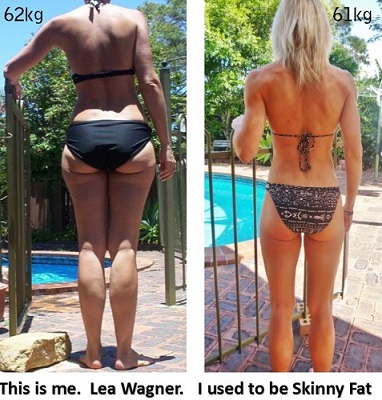
Skinny usually is associated with underweight, while fat is associated with overweight. The medical term for this is “MONW,” or metabolically obese normal weight. It means you are under lean but over fat — not enough muscle and too much fat (especially belly fat).
Skinny fat refers to someone with unappreciable levels of muscle mass, associated to a high percentage of body fat.
Here are four reasons why people achieve the skinny fat look
1 Doing too much cardio
Research is fairly clear on this. If strength and muscle hypertrophy is your goal, aerobic work will interfere with that goal. Aerobic exercise will cannibalize muscle mass.
2 Eating far too less
Of course, the natural thing to do when attempting to shed body fat is to restrict caloric intake. Skinny fat people take this axiom way too far. If you want to hold onto your muscle mass while restricting your calories, upping your protein intake is key.
To understand the mechanisms, read these research papers
3 Being afraid of consuming fats
Skinny fat people share dietary fat phobia as one of their pitfalls. For example, they are the ones that post on Facebook comments such as “Won’t eating nuts make you fat?”
However the research points to quite the opposite, see below references 8 to 34.
It makes me laugh when I see dietitians recommend “low fat snacks” such as pretzels over nuts like pistachios to obese, while the research shows them to be completely wrong:
If anything, regular nut consumption helps achieve optimal body composition.
4 Abstaining for strength training
Strength training has more benefits for body composition positive changes than the general population thinks.
General Health – increase good cholesterol, & decrease bad cholesterol, reduces risk of diabetes, reduce risk of cardiovascular disease, lower high blood pressure, lowers risk of breast cancer, decreases risk of osteoporosis, reduces symptoms of PMS, reduces stress & anxiety, decreases colds & illness.
Strength – increased muscle strength power, endurance & size. This is help you with everyday tasks like lifting, carrying, walking etc.
Flexibility – working your muscles through their full range of motion, weight training can improve your body’s overall flexibility.
Body Composition – Weight training will boost your metabolism. You will burn more calories at rest. Reduce your body fat. Your overall body weight may not change, but you will gain muscle and lose fat. Your measurements will decrease.
Muscle Tone – firmer & better defined muscles.
State of Mind – Weight training allows you to sleep better. Clinical studies have shown regular exercise to be one of the 3 best tools for effective stress management.
Simply put, if you want to achieve a physique that spells respect, avoid the four given pitfalls.
This is what the research has to say, here are some key references:
1. Jones TW, Howatson G, Russell M, French DN, Performance and neuromuscular adaptations following differing ratios of concurrent strength and endurance training, J Strength Cond Res. 2013 Mar 21.
2. Nader GA, Concurrent strength and endurance training: from molecules to man, Med Sci Sports Exerc. 2006 Nov;38(11):1965-70.
3. Hawley JA Molecular responses to strength and endurance training: are they incompatible? Appl Physiol Nutr Metab. 2009 Jun;34(3):355-61. doi: 10.1139/H09-023
4. Phillips SM, Zemel MB., Effect of protein, dairy components and energy balance in optimizing body composition, Nestle Nutr Inst Workshop Ser. 2011;69:97-108; discussion 108-13. doi: 10.1159/000329288
5. Labayen I, Díez N, González A, Parra D, Martínez JA, Effects of protein vs. carbohydrate-rich diets on fuel utilisation in obese women during weight loss, Forum Nutr. 2003;56:168-70.
6. Phillips SM, Dietary protein for athletes: from requirements to metabolic advantage, Appl Physiol Nutr Metab. 2006 Dec;31(6):647-54
7. Kreider RB, Rasmussen C, Kerksick CM, Wilborn C, Taylor L, Campbell B, Magrans-Courtney T, Fogt D, Ferreira M, Li R, Galbreath M, Iosia M, Cooke M, Serra M, Gutierrez J, Byrd M, Kresta JY, Simbo S, Oliver J, Greenwood M, A carbohydrate-restricted diet during resistance training promotes more favorable changes in body composition and markers of health in obese women with and without insulin resistance, Phys Sportsmed. 2011 May;39(2):27-40. doi: 10.3810/psm.2011.05.1893.
8. Tan SY, Dhillon J, Mattes RD, A review of the effects of nuts on appetite, food intake, metabolism, and body weight. Am J Clin Nutr. 2014 Jul;100 Suppl 1:412S-22S. doi: 10.3945/ajcn.113.071456. Epub 2014 Jun 11.
9. Mattes RD, Dreher ML, Nuts and healthy body weight maintenance mechanisms, Asia Pac J Clin Nutr. 2010;19(1):137-41.
10. Rachel C. Brown, Siew Ling Tey, Andrew R. Gray, Alexandra Chisholm, Claire Smith Elizabeth Fleming and Winsome Parnell, Association of Nut Consumption with Cardiometabolic Risk Factors in the 2008/2009 New Zealand Adult Nutrition Survey, Nutrients 2015, 7(9), 7523-7542; doi:10.3390/nu7095351
11. Noakes M1, Keogh JB, Foster PR, Clifton PM, Effect of an energy-restricted, high-protein, low-fat diet relative to a conventional high-carbohydrate, low-fat diet on weight loss, body composition, nutritional status, and markers of cardiovascular health in obese women., Am J Clin Nutr. 2005 Jun;81(6):1298-306.
12. Luscombe-Marsh ND, Noakes M, Wittert GA, Keogh JB, Foster P, Clifton PM, Carbohydrate-restricted diets high in either monounsaturated fat or protein are equally effective at promoting fat loss and improving blood lipids., Am J Clin Nutr. 2005 Apr;81(4):762-72.
13. Yancy WS Jr, Olsen MK, Guyton JR, Bakst RP, Westman EC, A low-carbohydrate, ketogenic diet versus a low-fat diet to treat obesity and hyperlipidemia: a randomized, controlled trial, Ann Intern Med. 2004 May 18;140(10):769-77
14. Hu T, Mills KT, Yao L, Demanelis K, Eloustaz M, Yancy WS Jr, Kelly TN, He J, Bazzano LA, Effects of low-carbohydrate diets versus low-fat diets on metabolic risk factors: a meta-analysis of randomized controlled clinical trials, Am J Epidemiol. 2012 Oct 1;176 Suppl 7:S44-54. doi: 10.1093/aje/kws264
15. Chaparro CM, Dewey KG., Use of lipid-based nutrient supplements (LNS) to improve the nutrient adequacy of general food distribution rations for vulnerable sub-groups in emergency settings, Matern Child Nutr. 2010 Jan;6 Suppl 1:1-69. doi: 10.1111/j.1740-8709.2009.00224.x.
16. Chandrasekharan N, Changing concepts in lipid nutrition in health and disease, Med J Malaysia. 1999 Sep;54(3):408-27; quiz 428.
17. Chong YH, Ng TK, Effects of palm oil on cardiovascular risk, Med J Malaysia. 1991 Mar;46(1):41-50
18. Bannenberg G, Serhan CN, Specialized pro-resolving lipid mediators in the inflammatory response: An update, Biochim Biophys Acta. 2010 Dec;1801(12):1260-73. doi: 10.1016/j.bbalip.2010.08.002. Epub 2010 Aug 10.
19. van Het Hof KH, West CE, Weststrate JA, Hautvast JG, Dietary factors that affect the bioavailability of carotenoids, J Nutr. 2000 Mar;130(3):503-6.
20. Lucci P, Borrero M, Ruiz A, Pacetti D, Frega NG, Diez O, Ojeda M, Gagliardi R, Parra L, Angel M, Palm oil and cardiovascular disease: a randomized trial of the effects of hybrid palm oil supplementation on human plasma lipid patterns, Food Funct. 2015 Oct 21. [Epub ahead of print]
21. Berrougui H, Ikhlef S, Khalil A, Extra Virgin Olive Oil Polyphenols Promote Cholesterol Efflux and Improve HDL Functionality, Evid Based Complement Alternat Med. 2015;2015:208062. doi: 10.1155/2015/208062. Epub 2015 Oct 1
22. Virruso C, Accardi G, Colonna-Romano G, Candore G, Vasto S, Caruso C., Nutraceutical properties of extra-virgin olive oil: a natural remedy for age-related disease? Rejuvenation Res. 2014 Apr;17(2):217-20. doi: 10.1089/rej.2013.1532.
23. Berge K, Musa-Veloso K, Harwood M, Hoem N, Burri L, Krill oil supplementation lowers serum triglycerides without increasing low-density lipoprotein cholesterol in adults with borderline high or high triglyceride levels, Nutr Res. 2014
24. Jacobson TA, Glickstein SB, Rowe JD, Soni PN, Effects of eicosapentaenoic acid and docosahexaenoic acid on low-density lipoprotein cholesterol and other lipids: a review, J Clin Lipidol. 2012 Jan-Feb;6(1):5-18. doi: 10.1016/j.jacl.2011.10.018. Epub 2011 Nov 3
25. Wei MY, Jacobson TA, Effects of eicosapentaenoic acid versus docosahexaenoic acid on serum lipids: a systematic review and meta-analysis, Curr Atheroscler Rep. 2011 Dec;13(6):474-83. doi: 10.1007/s11883-011-0210-3.
26. Marik PE, Varon J., Omega-3 dietary supplements and the risk of cardiovascular events: a systematic review, Clin Cardiol. 2009 Jul;32(7):365-72. doi: 10.1002/clc.20604
27. Carol E. O’Neil, Theresa A. Nicklas and Victor L. Fulgoni, Tree Nut Consumption Is Associated with Better Nutrient Adequacy and Diet Quality in Adults: National Health and Nutrition Examination Survey 2005–2010, Nutrients 2015, 7(1), 595-607; doi:10.3390/nu701059
28. Article: Almonds May Help Reduce Risk Of Type 2 Diabetes And Heart Disease, Monday 20 December 2010, http://www.medicalnewstoday.com/
29. Natoli S, McCoy P, A review of the evidence: nuts and body weight, Asia Pac J Clin Nutr. 2007;16(4):588-97.
30. Rajaram S, Sabaté J., Nuts, body weight and insulin resistance, Br J Nutr. 2006 Nov;96 Suppl 2:S79-86.
31. Westerterp-Plantenga MS, Fat intake and energy-balance effects, Physiol Behav. 2004 Dec 30;83(4):579-85
32. Mattes RD, The energetics of nut consumption, Asia Pac J Clin Nutr. 2008;17 Suppl 1:337-9.
33. Mattes RD, Kris-Etherton PM, Foster GD. Impact of peanuts and tree nuts on body weight and healthy weight loss in adults, J Nutr. 2008 Sep;138(9):1741S-1745S.
34. Li Z, Song R, Nguyen C, Zerlin A, Karp H, Naowamondhol K, Thames G, Gao K, Li L, Tseng CH, Henning SM, Heber D, Pistachio nuts reduce triglycerides and body weight by comparison to refined carbohydrate snack in obese subjects on a 12-week weight loss program. J Am Coll Nutr. 2010 Jun;29(3):198-203
35. Fatouros IG, Chatzinikolaou A, Tournis S, Nikolaidis MG, Jamurtas AZ, Douroudos II, Papassotiriou I, Thomakos PM, Taxildaris K, Mastorakos G, Mitrakou A, Intensity of resistance exercise determines adipokine and resting energy expenditure responses in overweight elderly individuals, Diabetes Care. 2009 Dec;32(12):2161-7. doi: 10.2337/dc08-1994. Epub 2009 Sep 3.
36. Ballor DL, Katch VL, Becque MD, Marks CR, Resistance weight training during caloric restriction enhances lean body weight maintenance, Am J Clin Nutr. 1988 Jan;47(1):19-25.
http://www.huffingtonpost.com/dr-mark-hyman/skinny-fat_b_1799797.html
A calorie is a calorie. Just eat less and exercise more. That’s what they say. And here’s why they’re dead wrong.
Ready to get fit after the birth of your new baby? Jamie Eason is here to help. Check out her upcoming 12-week post-pregnancy plan and learn how you can achieve the best shape of your life!